
How a 61-Metre Storm Pipe Is Pulled Underground Without Digging a Trench
July 7, 2026
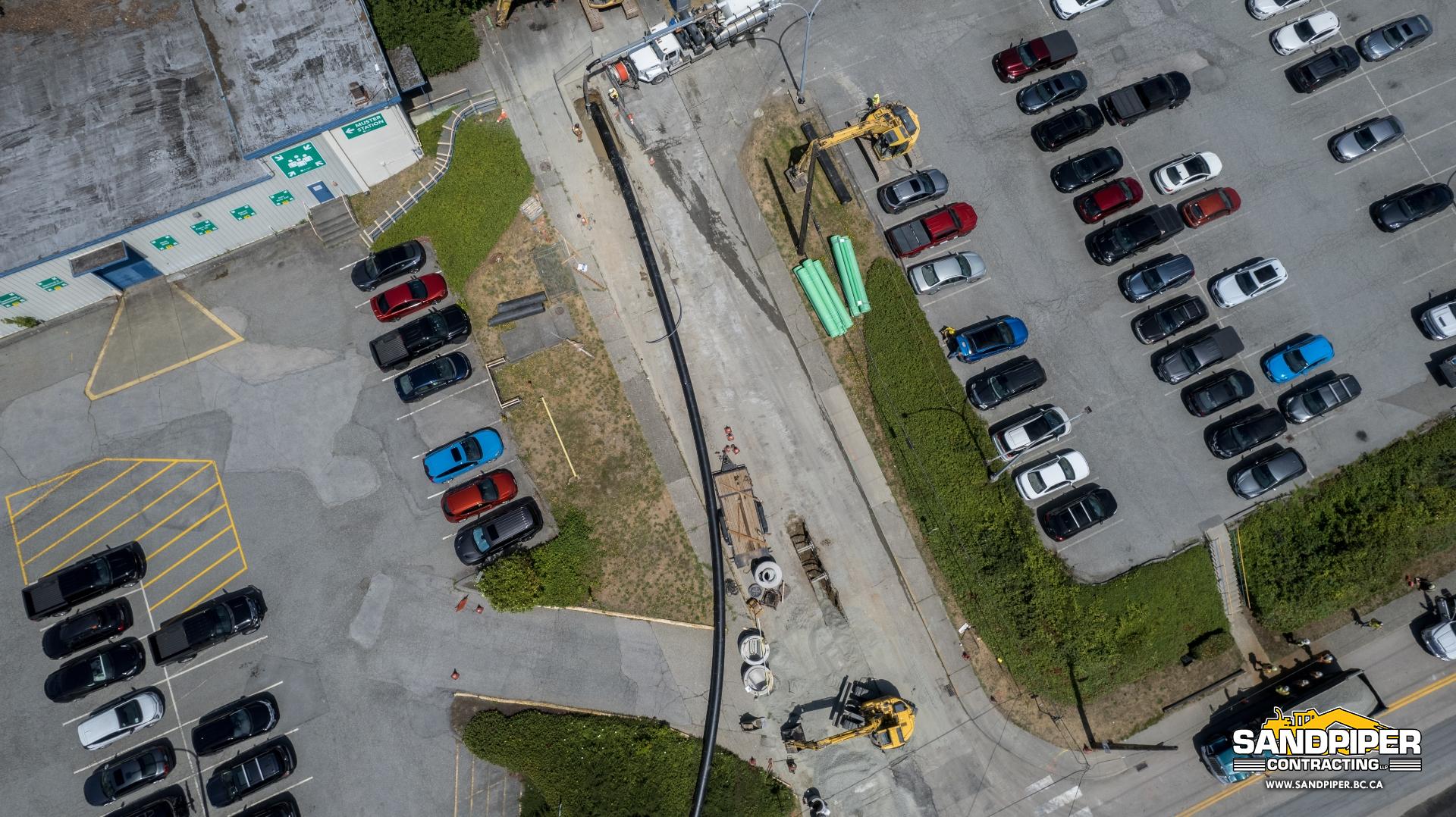
Sandpiper Contracting, in partnership with Directional Mining & Drilling, has successfully installed a continuous 61-metre (200-foot) section of 24-inch HDPE storm pipe beneath Stewardson Way and the SkyTrain Expo Line in New Westminster using Horizontal Directional Drilling (HDD)
The achievement is particularly significant given the location. More than 41,000 vehicles travel along Stewardson Way every day, the majority of them commercial trucks. Above the roadway, up to 700 SkyTrain trips pass over the Expo Line on a typical weekday. Maintaining traffic flow and uninterrupted rail service throughout construction was a key project requirement. Rather than excavating open trenches across one of the region's busiest transportation corridors, the team drilled a continuous underground bore along 16th Street, from 6th Avenue to 5th Avenue, before pulling the entire pipeline into place in a single operation. ''We chose to drill horizontally beneath the roadway and pull one continuous piece of pipe through a bore approximately 3.8 metres underground,'' says Bryan Mills, Superintendent with Sandpiper Contracting. ''To most people driving or riding overhead, the work happened completely out of sight.'' Before the pullback could begin, crews fused individual sections of HDPE pipe together on site, creating one continuous 61-metre pipeline capable of being installed in a single pull. According to Shawn Sedlar, Project Manager with Directional Mining & Drilling, precision is critical from the very beginning. ''We first drill a pilot hole that follows the engineered alignment to ensure we hit every design invert and stay exactly on grade,'' explains Sedlar. ''Once the drill string reaches the exit point, we progressively enlarge the bore using 18-inch, 24-inch, and finally 30-inch reamers. That creates enough clearance to safely pull the 24-inch pipe through.'' Once the bore was fully prepared, the crew connected the pipeline to a 32-inch hole opener fitted with clevises and swivels. As the hole opener rotated through the ground, the swivels allowed the pipe to remain stationary, preventing it from twisting while it was pulled smoothly into the bore. Watching a 61-metre pipeline disappear underground is an unusual sight—even for experienced construction crews. ''The first few minutes are surprisingly dramatic,'' says Dan Bruton of DMC Engineering, who was on site during the pullback. ''There's a tremendous amount of energy as the reamer starts moving.'' Sedlar explains why. ''At the beginning, the reamer is still outside the bore, so there's nothing to stabilize its movement,'' he says. ''Once it enters the bore hole, the surrounding ground contains that energy and the pull becomes much smoother.'' Roughly four hours later, the crew's attention shifted to the receiving pit nearly 100 metres away on the north side of Stewardson Way. Soon, the unmistakable sound of the reamer echoed from the excavation. Moments later, the mud-covered hole opener emerged, followed closely by the leading end of the newly installed storm pipe. ''The entire pipeline weighs about 12,000 pounds,'' says Sedlar. ''The bore is larger than the pipe, and the ground consists of extremely dense till, so friction within the stable bore can be relatively low, allowing the pipe to be pulled through smoothly despite its size.'' The HDD portion of the installation took just two weeks to complete. Had the project been constructed using traditional open-cut excavation, traffic disruptions would likely have lasted for several months, significantly affecting both nearby residents and the tens of thousands of motorists who rely on Stewardson Way each day. With the crossing now complete, the project moves into a more familiar phase as crews continue installing the remainder of the storm system using conventional excavation methods. We've been working with Sandpiper on a trenchless storm main installation project for over a year, and it's been a great experience from start to finish. For this project, Sandpiper chose horizontal directional drilling to avoid removing and reconstructing retaining walls along Stewardson Way and around the SkyTrain infrastructure, which would have required significant engineering and added complexity. It also eliminated the need to excavate across Stewardson Way—a major arterial route in the City of New Westminster—avoiding major traffic disruptions. Sandpiper worked closely with us throughout the design process to develop a solution that kept traffic flowing while meeting the project's technical requirements. Throughout construction, they've been responsive, organized, and proactive. Whenever we've needed something, their team has been quick to respond and keep the project moving. Working with Sandpiper has been efficient, professional, and collaborative, and we've appreciated being part of the team on this project. Shawn Sedlar
Sub-Contractor Testimonial
Project Manager
Directional Mining & Drilling Ltd.
Click here to view this page online with additional details.
9342 194 St. Surrey, BC V4N 4E9
Tel: 604.888.8484
Fax :
Website: www.sandpiper.bc.ca